

pil·grim·age(n):
A long journey or search, especially one driven by an exalted purpose.
Wildflower Pilgrimage
Evening - Presentations Only
at the Paxton Theater in Bainbridge, OH
Friday, April 9; 7:15pm - 9pm
Saturday, April 10; 7:15pm - 9pm
$20/person
Please note: Evening presentations are already included in the full weekend registration. Purchase ONLY if you are NOT attending the full weekend event.

Please note: Evening presentations are already included in the full weekend registration. Purchase ONLY if are you not attending the full weekend event.
FRIDAY, April 9
7:15 – 9:00 pm Evening Presentation at the Paxton Theater – be sure to arrive no later than 7 pm to provide plenty of time for parking and walking to the theater.
The Hidden Lives of Trillium: Comparative Life Histories of Japanese and North American Species
By exploring and comparing Trillium species across the two regions of Eastern North America and Japan, he will raise our awareness of the world significance of this specialized and incredibly beautiful genus. With the knowledge Professor Ohara has gained by following the life history of individual trillium plants and populations over many years, he will share with us how Trilliums grow, reproduce, and change over what has proven to be impressively extended lifetimes. He will also share insights on their reproductive ecology and seed dispersal, including the remarkable relationship between Trillium seeds and ants. This presentation will reveal the extraordinary complexity of these beautiful spring wildflowers and offer new perspectives on plant evolution and forest ecology.
SATURDAY, April 10
7:15 – 9:00 pm Evening Presentation at the Paxton Theater – be sure to arrive no later than 7 pm to provide plenty of time for parking and walking to the theater.
The Sister Forests of Japan & Eastern United States by Elijah Crabtree, Arc Naturalist
Did you know that forests of Eastern United States share a remarkable number of plant genera with the temperate forests of Japan? When closely-related plants show up in both eastern Asia and Eastern United States, but nowhere else in the world, they point to a time in our geologic past when these two forests were once united, even though, today, they occupy opposite corners of the planet. We will learn more about our special connection, including the specific plants we share in common that are completely missing from the European temperate forests, and why this may be so. You will never look at our backyard forests quite the same way again!
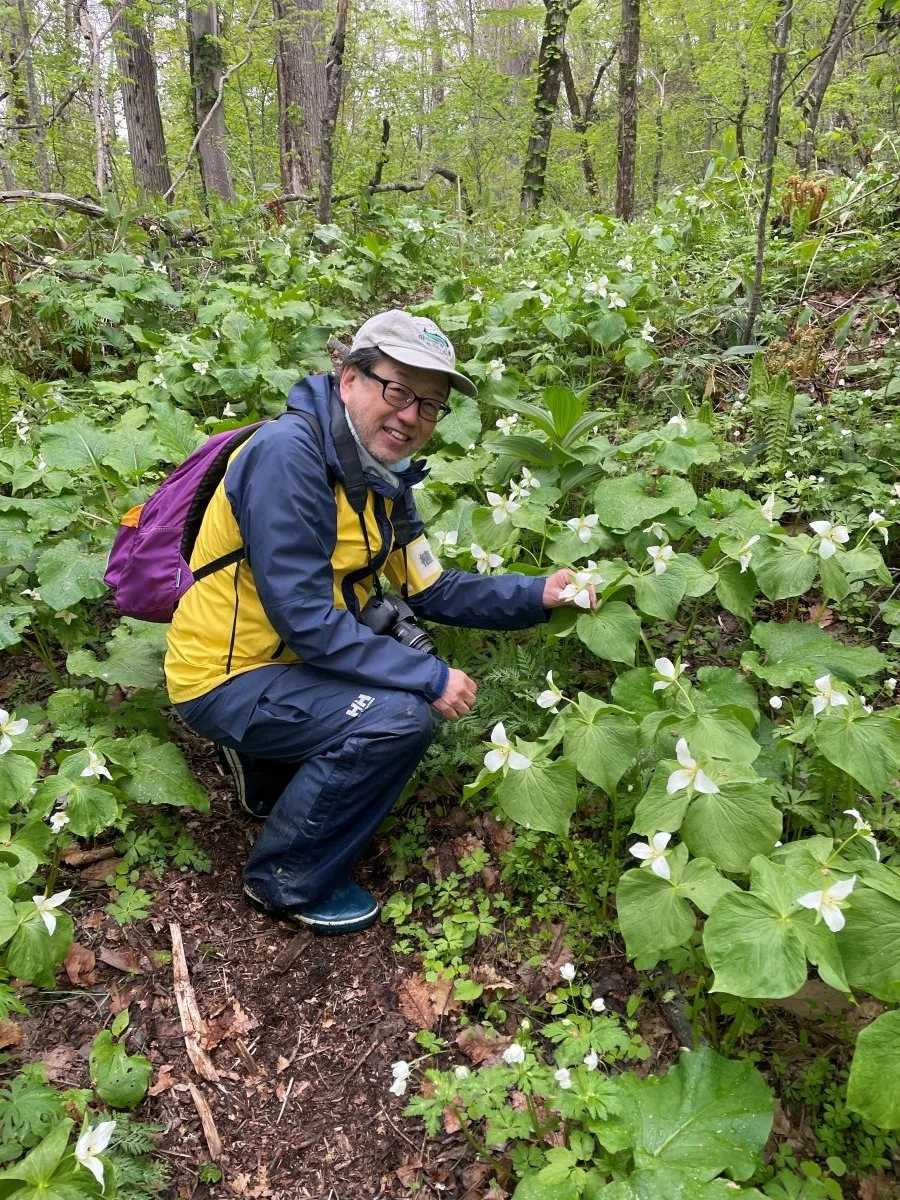

Professor Masashi Ohara is a Japanese botanist and plant ecologist whose decades of research have contributed to our understanding of the biology, ecology, and evolution of Trillium, a distinctive spring wildflower found in the forests of Japan and North America. For more than four decades, Professor Ohara has studied the evolution, reproduction, genetics, and ecology of Trillium species in Japan, as well as their comparative life histories in Japan and North America. During his doctoral studies, he conducted research on North American Trillium at the Carnegie Museum of Natural History in Pittsburgh, in collaboration with botanist Frederick H. Utech. His comparative studies across Japan and North America have provided a broader perspective on the diversity and evolution of Trillium life histories. His long-standing career at Hokkaido University in Sapporo provided a foundation for extensive field research and long-term studies of these fascinating woodland perennials. He is now Professor Emeritus at Hokkaido University. Professor Ohara’s research has focused particularly on the life histories of Trillium, exploring how individual plants grow, reproduce, change through their lifetimes, and persist within forest ecosystems. A defining feature of his work is the combination of detailed field observation with long-term demographic studies. By following individual plants and populations over many years, he has helped reveal aspects of the life cycles of Trillium that cannot be understood through short-term observations alone. His research has also examined the reproductive ecology and seed dispersal of Trillium, including the fascinating relationship between Trillium seeds and ants. Ant-mediated seed dispersal plays an important role in the movement and establishment of these plants within forest communities, and Professor Ohara’s work has contributed to a deeper understanding of this ecological relationship. Through decades of careful field research, Professor Ohara has sought to uncover the hidden lives of plants that many people know primarily for their beautiful spring flowers. His work demonstrates how long-term observation can transform our understanding of a familiar woodland plant, revealing its complex life history, evolutionary history, and ecological relationships.
Elijah Crabtree is an Education Specialist and Naturalist for the Arc of Appalachia. He was born and raised in Chillicothe, Ohio where he acquired a passion and keen interest in the natural and cultural history of Appalachian Ohio. This led him to his former on-site residency at the Tremper Mound Preserve, overseeing its development as a management and educational hub. In 2025, he joined the administrative team as an Education Specialist to organize, coordinate and lead many of the Arc’s Naturalist Programs. Elijah is an avid student of natural sciences and loves to spend his time studying and appreciating Ohio’s geology and botany.